
Risk Warning:
CFDs, Forex, and Cryptocurrencies are complex instruments and come with a high risk of losing money rapidly due to leverage and extreme market volatility. You should consider whether you understand how these markets work, and whether you can afford to take the high risk of losing your money.
You do not own or have rights in the underlying assets. Past performance, including the success rates of previous signals or copy trading strategies, is no indication of future performance.
No Financial Advice:
The information provided by SRFXGlobal—including but not limited to VIP signals, chart analysis, mentorship programs, Telegram alerts, and content distributed across all platforms—is strictly for educational and informational purposes. It is general in nature and does not constitute professional financial, investment, or trading advice. It does not take into account your personal objectives, financial circumstances, or needs.
Service Disclaimer:
Service Disclaimer: Engaging in copy trading, utilizing account management services, or following trading signals carries inherent risks. SRFXGlobal and its team are not liable for any financial losses incurred as a result of using our services, following our analysis, or executing trades based on our alerts. Technical factors, such as execution delays or platform latency, may impact results. Trading in financial markets involves significant risk, and you are solely responsible for your own trading decisions.
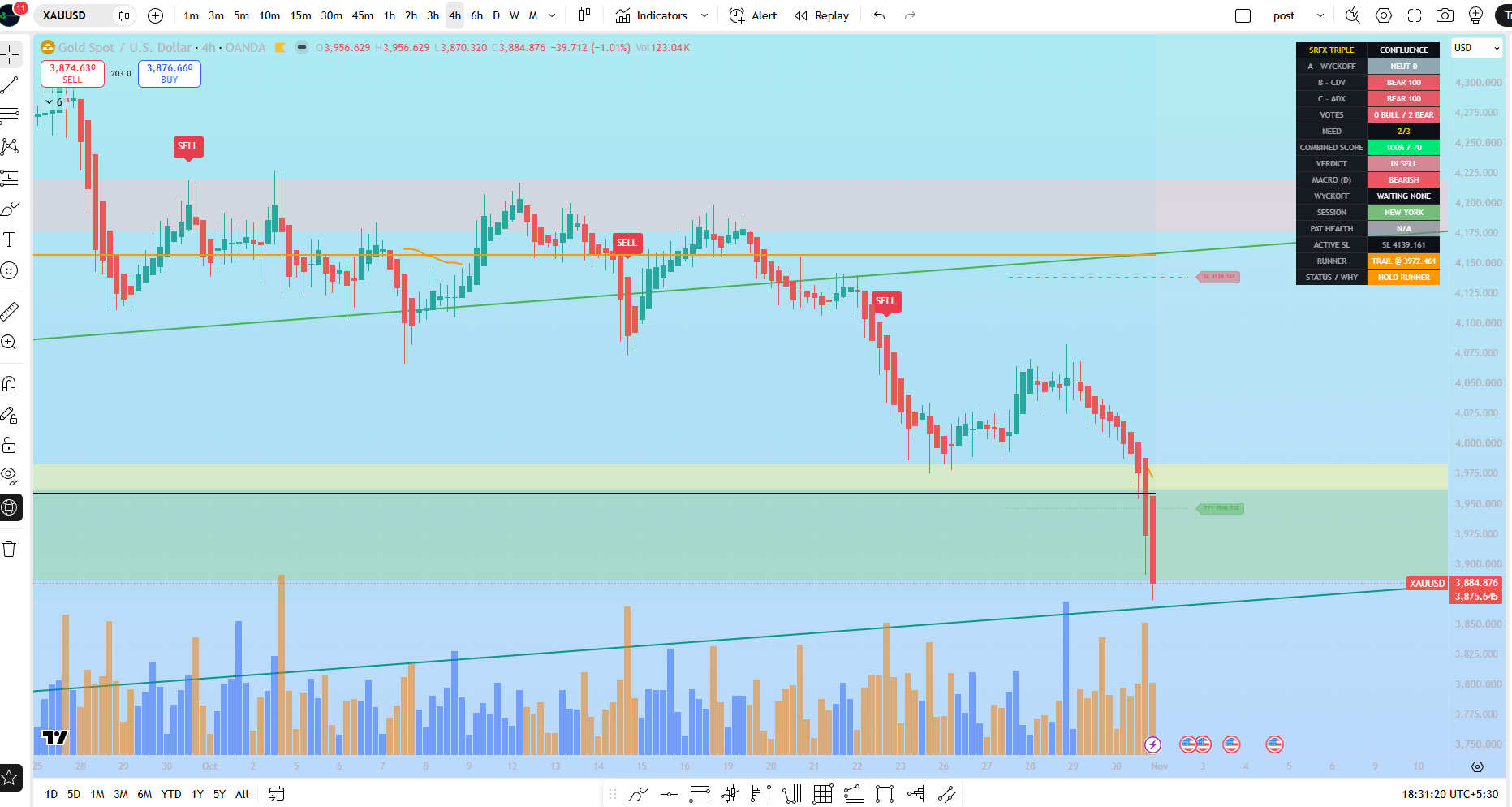
Three Analytical Engines. One Clear Confluence View.
SRFX Triple Confluence — Signal & Risk Toolkit brings structure, volume pressure, and trend strength into one organised TradingView indicator.
Its configurable voting system evaluates agreement between three analytical engines, while a weighted score measures the strength of that agreement. A compact dashboard explains the current bias, qualifying conditions, and reasons to wait—helping you assess confirmation before considering entry.
The Three Engines
1. Wyckoff / SMC — Market Structure
Track developing accumulation and distribution structures through Wyckoff events such as springs, upthrusts, signs of strength or weakness, and last points of support or supply.
Supporting context from fair-value gaps, liquidity sweeps, and order-block proximity helps refine the structural assessment. A pattern-health read indicates whether the structure is holding, progressing, or showing signs of failure.
2. Cumulative Delta Proxy — Volume Pressure
Assess buying and selling pressure using a cumulative measure derived from each candle’s closing position within its range, weighted by volume.
Higher-timeframe alignment, volume participation, an ADX threshold, and a separation filter help determine when this engine contributes a directional vote.
This is an OHLCV-based approximation—not exchange-native bid/ask delta. Its usefulness depends on the quality and type of volume supplied by your chart’s data feed.
3. ADX / DI — Trend Direction and Strength
Evaluate direction through DI+ and DI−, with an ADX threshold to distinguish trending conditions from weaker environments.
The engine’s score also considers ADX strength and slope, price alignment with a long-term EMA, and higher-timeframe confirmation.
Flexible Confluence Settings
Choose how much agreement your trading approach requires:
• Majority agreement: Use a configurable threshold, such as two of three engines.
• Strict agreement: Require every enabled engine to align.
• Weighted scoring: Adjust each engine’s contribution to the combined 0–100 score.
• Minimum score: Require sufficient strength as well as enough agreeing votes.
The combined score is an internal confluence measure, not a win-rate estimate or probability of success.
Additional Confirmation Filters
Optional filters allow you to refine when signals qualify:
• Higher-timeframe directional alignment.
• A trend-regime filter using EMA slope and price position.
• Session controls for selected trading hours.
• A cooldown between fresh same-direction entries.
The higher-timeframe “macro” read represents technical trend context; it is not an economic-news or fundamental analysis feed.
Clear Signals and Consistent State Tracking
BUY and SELL labels appear on qualifying transitions into a new virtual state or an opposite-direction reversal. Repeated same-direction entry labels are suppressed while that state remains active.
A strong marker highlights full agreement across all enabled engines. The indicator tracks one virtual position at a time to keep its signals, management references, and dashboard messages consistent.
Visual Risk-Management Guides
When a qualifying signal forms, the toolkit can display:
• Stop reference: Structure-based with an ATR buffer, or an ATR-based alternative.
• TP1 reference: A configurable risk-multiple target.
• Runner trail: An optional chandelier-style trailing reference after TP1.
• Break-even floor: An optional constraint on the runner’s trailing reference.
These levels support discretionary planning. They do not place orders, guarantee execution, or protect a live account automatically.
A Dashboard That Explains the Read
View the information behind each decision in one compact panel:
• Individual engine votes and scores.
• Bullish and bearish vote totals.
• Required votes and the combined-score threshold.
• Current verdict and higher-timeframe bias.
• Wyckoff context, pattern health, and session status.
• Active stop and runner-trail references.
• A STATUS / WHY explanation for waiting or holding.
When conditions do not qualify, the dashboard can identify reasons such as split votes, a low score, flat market conditions, a higher-timeframe conflict, session restrictions, or cooldown.
TradingView Alerts
Available alert conditions cover entries, strong entries, TP1 touches, and runner-trail hits.
Optional structured webhook messages include the symbol, timeframe, signal direction, price, vote tally, combined score, and relevant management references for compatible messaging workflows. External delivery requires separate configuration.
Calculation Transparency
Entry and reversal signals are evaluated on confirmed chart bars. Higher-timeframe readings can still change while their own candles remain open, and pivot-based structure detection requires confirmation time.
Management references may update on the forming bar. The virtual tracker begins management after the entry bar, assumes the stop is reached first when a bar touches both the stop and TP1 before TP1 has been reached, and checks runner exits against the previous bar’s closing trail reference.
These rules organise chart-based tracking; they do not reconstruct exact intrabar execution or broker fills.
Built for a Disciplined Workflow
Use SRFX Triple Confluence to organise your analysis, assess agreement, and plan trade management. Review market structure, nearby levels, and the dashboard’s explanation before considering entry.
Important Information
SRFX Triple Confluence is an educational market-analysis indicator, not an automated trading strategy or a backtesting system. Signals and scores do not guarantee outcomes. Trading involves risk; apply your own risk-management plan and confirm execution on your trading platform.


