


Global markets are digesting two major sources of risk at the same time on Wednesday, November 4, 2026: a major shift in the U.S. political landscape after the midterm elections, and renewed uncertainty over the U.S.–Iran conflict, the Strait of Hormuz and Middle East oil supply. The combination has already triggered a clear cross-market reaction. U.S. media projections show Democrats are on track to regain control of the House of Representatives, while the Senate balance is still developing after several Democratic pickups in states including North Carolina, Ohio, Kansas and Iowa. Reuters reported that the stronger-than-expected Democratic performance pressured the U.S. Dollar and equity futures while supporting Treasury bonds. At the same time, the Iran conflict remains unresolved. Qatar is still mediating between Washington and Tehran, but a senior Iranian official told Reuters that the two sides remain far apart. The United States also carried out limited defensive strikes on Iran’s Qeshm Island in the Strait of Hormuz on November 3, adding fresh uncertainty to an already fragile peace process. For traders, the key issue is that the market is now balancing.
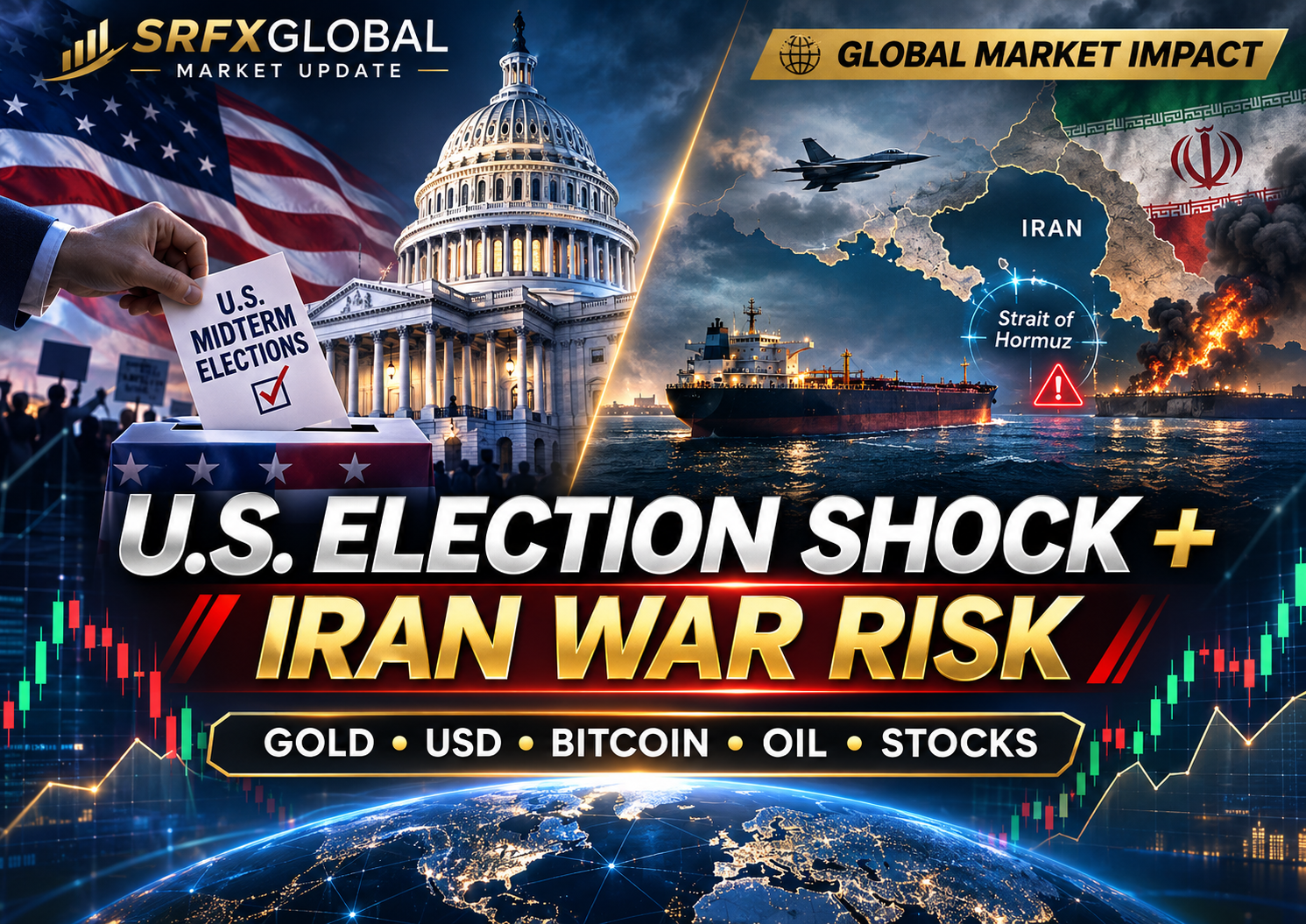
Political gridlock and weaker U.S. fiscal expectations
against
Middle East escalation, oil risk and inflation pressure.
That creates a highly sensitive environment for Gold, the U.S. Dollar, Treasury yields, Bitcoin, crude oil and U.S. stock indices.
2026 U.S. Midterms: What Has Changed?
Republicans entered the election with a very narrow 218–214 majority in the House and a 53–47 majority in the Senate.
By early Wednesday, U.S. media projected that Democrats would regain control of the House of Representatives. Reuters also reported important Democratic Senate victories in North Carolina and Ohio, alongside other competitive gains that strengthened the party’s position in the fight for Senate control.
Because counting is still continuing in several races, traders should distinguish carefully between:
projected control
and
fully certified election results.
At the time of writing, the House shift is projected by major U.S. media, while the final Senate balance remains dependent on remaining races and counts.
Why the Midterm Result Matters for Markets
The election result matters because control of Congress affects:
federal spending,
tax policy,
AI and technology regulation,
financial regulation,
healthcare policy,
debt-ceiling negotiations,
defense spending,
and the broader fiscal outlook.
Reuters noted that investors were already preparing for tighter oversight in areas such as AI, banking and cryptocurrencies if Democrats gained congressional control.
The immediate market interpretation has been that stronger Democratic gains could reduce expectations for additional fiscal stimulus and produce more political gridlock.
That matters because lower expected fiscal expansion can reduce pressure on Treasury yields and the Dollar.
Immediate Market Reaction to the Election
Reuters reported the following early market moves on Wednesday:
S&P 500 futures: approximately -1.2%
Nasdaq futures: down more than 2%
U.S. 10-Year Treasury yield: down around 6 basis points to 4.906%
Dollar Index: approximately -0.37% to 101.34
EUR/USD: around 1.1249
GBP/USD: around 1.3464.
That is an important signal.
The first market response is:
Stocks ↓
Dollar ↓
Treasury yields ↓
This suggests investors are pricing a combination of:
less fiscal stimulus,
greater regulatory uncertainty,
and more political gridlock.
Why Nasdaq Is Under More Pressure
The Nasdaq is reacting more negatively than the broader market.
Reuters reported that investors are concerned that a change in congressional control could lead to greater regulatory scrutiny of:
AI companies
Big Tech
data-center expansion
and
technology investment.
This comes at a time when markets are already questioning the scale and profitability of AI-related capital spending.
That makes technology stocks especially sensitive to:
regulation + high valuations + high borrowing costs.
Therefore, even if Treasury yields fall, Nasdaq may remain under pressure if regulatory concerns dominate.
U.S.–Iran War: Latest Situation
The Middle East remains the second major market driver.
Reuters reported on November 3 that Iran and the United States are still far apart on a deal to end the conflict, even as Qatar continues mediation.
Qatar has presented proposals aimed at narrowing the gap between Washington and Tehran.
Iran has indicated that reopening the Strait of Hormuz depends on several conditions, including:
easing oil sanctions,
ending the U.S. naval blockade,
and releasing frozen Iranian funds.
Qatar said both sides are still reviewing proposals and that negotiations are continuing.
That means the diplomatic channel remains open.
But there is still no confirmed breakthrough.
U.S. Strikes on Qeshm Island Keep Escalation Risk Alive
The United States carried out strikes on Iran’s Qeshm Island on November 3.
A U.S. official described the action as defensive and said the strikes targeted surface-to-air missiles being used against U.S. assets.
Another official said the strikes were limited and did not represent a return to full-scale combat operations.
Even so, the incident is important for markets because Qeshm Island sits in the Strait of Hormuz, the world’s most important oil-shipping chokepoint.
Any renewed military escalation around the Strait can immediately affect:
Brent
WTI
inflation expectations
Treasury yields
Gold
and
risk sentiment.
Strait of Hormuz Remains the Key Energy Risk
Before the war, the Strait of Hormuz carried approximately 20% of global oil supplies.
Reuters reported that the effective blockade of the Strait has already reshaped global energy flows and contributed to higher inflation and interest-rate pressure.
Saudi Aramco is now expanding infrastructure that bypasses the Strait, highlighting how seriously regional producers are treating the long-term risk.
The central market question is therefore:
Can diplomacy restore normal Hormuz flows before another military escalation disrupts supply again?
Oil Market Reaction
Oil prices fell in the previous session as traders focused on hopes for peace talks.
Reuters reported:
Brent: $103.60
WTI: $96.09
with both benchmarks closing near four-week lows on Tuesday.
However, oil remains extremely sensitive to headlines.
There are two opposing forces:
Oil Bearish
Peace talks progress
Hormuz reopening hopes
more supply returning
Oil Bullish
U.S.–Iran escalation
tanker attacks
Hormuz restrictions
geopolitical supply disruption
That means crude prices can reverse sharply on any fresh diplomatic or military headline.
Gold / XAUUSD Outlook
Gold is exposed to both sides of the current story.
Gold Bullish Factors
Democratic gains in Congress
→ lower Treasury yields
→ weaker Dollar
→ supportive for Gold.
At the same time:
Iran escalation
→ safe-haven demand
→ potentially supportive for Gold.
Gold Bearish Risk
If the U.S.–Iran conflict drives oil sharply higher:
Oil ↑ → inflation risk ↑ → Fed tightening expectations ↑ → yields ↑
That can create pressure on Gold even during a geopolitical crisis.
This is why Gold traders should not assume:
War = automatically bullish Gold.
The key confirmation remains:
US2Y → US10Y → DXY → Gold structure
before considering entry.
U.S. Dollar / Forex Outlook
The Dollar has initially weakened after the midterm results.
Reuters reported the Dollar Index around 101.34, down approximately 0.37%.
The election-driven logic is:
More political gridlock → less fiscal stimulus → lower yields → weaker USD.
However, the Iran conflict can support the Dollar through two channels:
Safe-Haven Demand
Geopolitical stress can increase demand for U.S. liquidity.
Inflation / Fed Channel
Higher oil prices can increase inflation expectations and support higher U.S. interest rates.
Therefore the Dollar could reverse higher if Middle East escalation becomes the dominant market theme.
Treasury Yields
The 10-year Treasury yield fell around 6 basis points to 4.906% after early election results.
This suggests investors are reducing expectations for:
fiscal expansion
and
higher government borrowing pressure.
But the next major test is oil.
If Middle East risk sends crude sharply higher, long-term inflation expectations could rise again and push yields higher.
That creates the current rates battle:
Election gridlock → yields lower
versus
Iran / Oil inflation risk → yields higher.
Bitcoin and Major Crypto
Bitcoin is facing an unusually complex environment.
On one hand:
lower yields + weaker DXY
are generally supportive for crypto liquidity.
On the other hand:
election-related regulatory uncertainty,
risk-off equity sentiment,
and the recent Binance security breach
remain major headwinds.
Reuters reported that Binance clients withdrew approximately $4.7 billion after the exchange’s record $6.3 billion hack, although outflows later began stabilizing.
That means BTC is currently trading between:
macro liquidity support
and
crypto-specific confidence risk.
BTC Bullish
US2Y ↓
DXY ↓
Binance outflows stabilize
risk sentiment improves.
BTC Bearish
Nasdaq weakness extends
regulatory concerns rise
Iran escalation triggers broader risk-off
exchange liquidity deteriorates again.
S&P 500 / Nasdaq / Dow Jones
The initial equity reaction is clearly risk-off.
S&P 500 futures fell around 1.2%, while Nasdaq futures declined more than 2%.
The Nasdaq is most vulnerable because investors are worried about tighter oversight of:
AI
data centers
Big Tech
and
high-growth technology companies.
However, falling Treasury yields could eventually provide some support to equities.
That means a sustained stock selloff is not guaranteed.
The next confirmation should come from:
Treasury yields
AI-sector breadth
credit markets
and
U.S. cash-session price action.
Election + Iran Combined Scenario Matrix
Scenario 1 — Political Gridlock + Iran Talks Improve
Election uncertainty settles
Qatar mediation advances
Oil falls
yields decline
Potential Impact
Gold: supportive / mixed
USD: bearish
Treasuries: bullish
BTC: supportive
Nasdaq: recovery possible
Oil: bearish
Scenario 2 — Political Gridlock + Iran Escalation
Election results reduce fiscal expectations
but
military escalation returns.
Potential Impact
Gold: bullish safe-haven support possible
USD: mixed
Yields: highly volatile
BTC: risk-off
Stocks: bearish
Oil: sharply bullish
Scenario 3 — Election Uncertainty + Oil Shock
If election results remain contested while Middle East escalation worsens:
political uncertainty + inflation shock + risk-off
could become the dominant theme.
This would be the most unstable setup for financial markets.
SRFX Trading View
The key mistake traders can make now is focusing on only one headline.
The U.S. election and the Iran conflict are interacting through:
fiscal policy
regulation
oil
inflation
Treasury yields
and
risk sentiment.
The current first-read market reaction is:
Dollar ↓
Treasury yields ↓
Stocks ↓
while Oil remains headline-sensitive.
That suggests the election result is dominating the first move.
However, the Middle East can reverse that setup quickly.
A renewed Iran escalation can immediately produce:
Oil ↑ → inflation expectations ↑ → yields ↑ → USD ↑
while also increasing safe-haven demand for Gold.
Therefore traders should monitor the full chain:
Election Results → Treasury Yields → DXY → Oil → Gold / BTC / Stocks
before considering entry.
What Traders Should Watch Next
1. Final House and Senate Control
Current results remain media projections until counting and certification progress further.
2. U.S.–Iran Diplomatic Feedback
Qatar said both sides are reviewing proposals.
3. Hormuz Reopening Conditions
Iran still links reopening to sanctions, blockade and frozen-funds demands.
4. Additional U.S. or Iranian Military Action
The Qeshm strike shows escalation risk remains active.
5. Brent and WTI
A sharp reversal higher would signal that geopolitical risk is overtaking diplomatic optimism.
6. US2Y and US10Y
These will show whether markets are pricing fiscal relief or renewed inflation risk.
7. DXY
A sustained break lower would confirm the election-driven weaker-Dollar narrative.
8. Gold, BTC and Nasdaq Structure
Wait for actual price confirmation rather than trading political headlines directly.
Risk Warning
Political and geopolitical events can change rapidly.
Election projections are not the same as final certified results.
Diplomatic talks can improve or collapse within hours.
Military actions around the Strait of Hormuz can create sudden:
oil spikes,
spread widening,
slippage,
safe-haven flows,
and rapid reversals.
Do not take blind entries based on a single election or war headline.
Confirm:
Treasury yields + DXY + Oil + price structure before considering entry.
Conclusion
The November 2026 market environment has shifted into a two-front risk story.
The U.S. midterm elections are reshaping expectations around:
fiscal policy
regulation
AI investment
debt
and
political gridlock.
At the same time, the U.S.–Iran war remains unresolved, with Qatar continuing mediation while limited U.S. military action around Qeshm Island keeps escalation risk alive.
The immediate market response has been:
Dollar weaker
Treasury yields lower
S&P and Nasdaq futures weaker
while
Oil remains extremely sensitive to Middle East headlines.
For Gold, Bitcoin and FX traders, the most important question is no longer simply:
Who controls Congress?
It is:
Will political gridlock reduce yields faster than Middle East escalation pushes inflation risk back higher?
That balance could determine the next major move across global markets.
Disclaimer:
This article is for educational and market-analysis purposes only. It does not constitute financial advice, a guaranteed trading signal or an investment recommendation. Election results, geopolitical negotiations and military developments can change rapidly and may cause extreme volatility across financial markets.


