


The Fed is expected to hold rates at 3.75%–4.00% on October 28. SRFXGlobal analyzes inflation, jobs, Treasury yields and the FOMC impact on Gold, USD, Bitcoin and U.S. stocks.
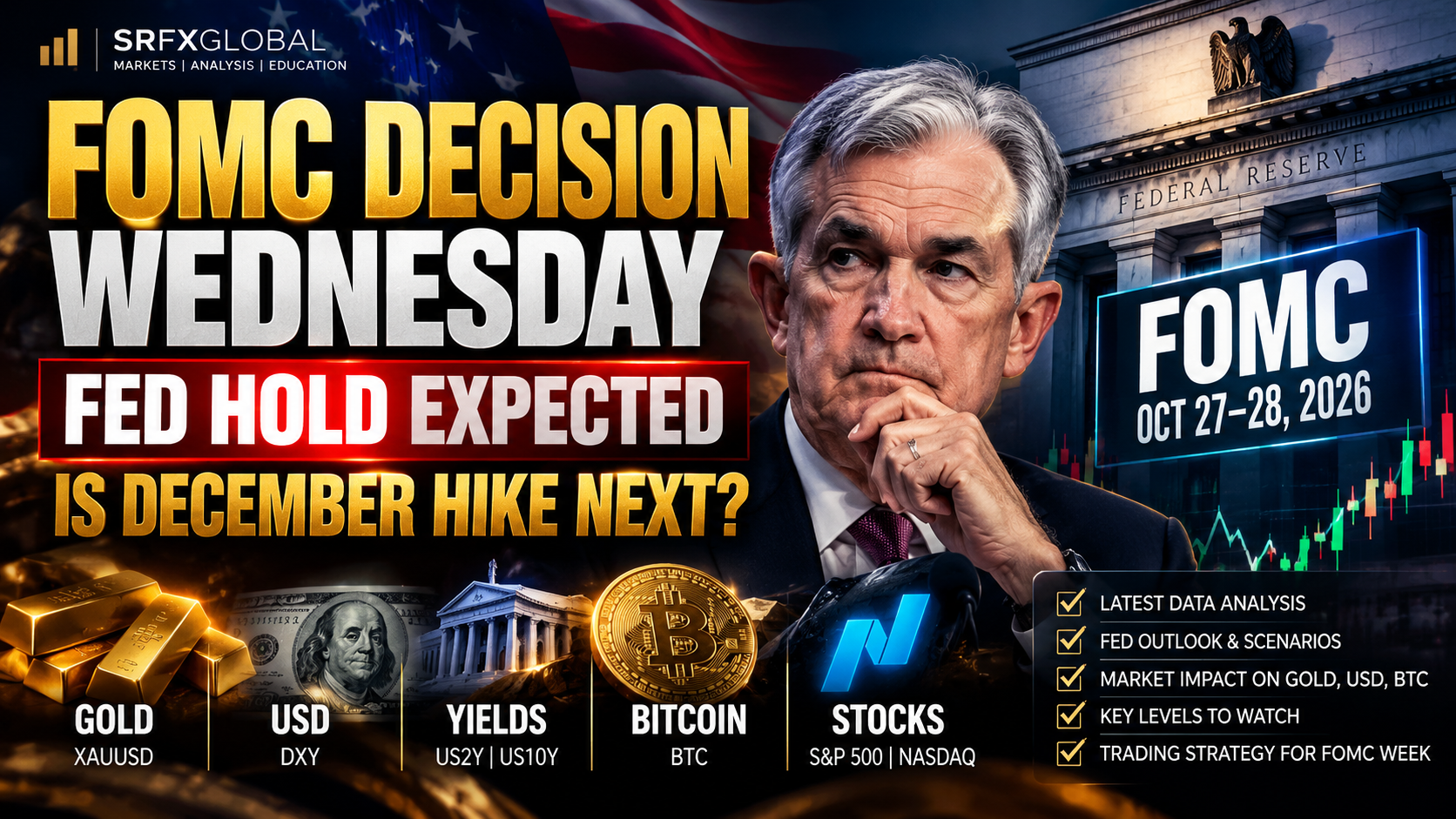
FOMC Preview: Fed Expected to Hold Rates — But Is Wednesday Just a Pause Before Another Hike?
The Federal Reserve heads into its October policy meeting with one of the most difficult combinations a central bank can face: inflation remains too high, the labor market has slowed without collapsing, economic growth is still resilient, energy prices remain elevated, and Treasury yields are already imposing significant tightening on financial conditions.
The Federal Open Market Committee meets on October 27–28, 2026, with the policy statement scheduled for 2:00 PM ET on Wednesday, October 28, followed by Fed Chair Kevin Warsh’s press conference at 2:30 PM ET. For traders in Sri Lanka, that means the decision arrives at approximately 11:30 PM on Wednesday, with the press conference beginning at 12:00 AM on Thursday, October 29.
The market’s base case is straightforward: the Fed is expected to keep the federal funds target range unchanged at 3.75%–4.00% after raising rates by 25 basis points in September.
But the real question for traders is not whether the Fed holds.
It is:
Will the Fed signal that October is merely a pause before another rate hike in December?
That distinction could determine the next major move in Gold/XAUUSD, the U.S. Dollar, Treasury yields, Bitcoin, major FX pairs and U.S. equity indices.
October FOMC: What Is the Market Expecting?
The Federal Reserve currently maintains its target range at 3.75%–4.00% following September’s rate increase. Reuters reports that policymakers are widely expected to leave rates unchanged this week, partly because the sharp rise in Treasury yields after the September hike has already tightened financial conditions.
FXStreet’s latest Fed previews also lean toward a hold. TD Securities expects no October change, while arguing that inflation risks remain elevated and that waiting now could make a December hike more likely. Danske Bank similarly expects a hold, with further tightening later if inflation remains persistent.
As of Monday, Reuters reported that traders were pricing a high probability of another rate increase in December, even while expecting the Fed to pause this Wednesday.
That makes this meeting fundamentally different from a normal “hold” decision.
A hold could still be hawkish.
The Economic Data Driving the Fed
1. Inflation Is Still the Fed’s Biggest Problem
September CPI accelerated sharply.
Headline CPI rose:
+0.6% month-on-month
and
+3.7% year-on-year
compared with 3.4% YoY in August.
Core CPI, excluding food and energy, rose:
+0.3% MoM
and
+2.6% YoY.
The headline increase was heavily influenced by energy, but underlying inflation was not weak enough to give the Fed comfort.
The reaction to the CPI report showed how sensitive markets remain to inflation surprises: Reuters reported a sharp rise in short-term Treasury yields, a stronger U.S. Dollar and pressure on Gold following the release.
For the Fed, this matters because its official inflation target remains 2%.
Inflation at 3.7% is still far above that objective.
2. Producer Inflation Is Even More Concerning
The September Producer Price Index delivered an even stronger inflation warning.
Final-demand PPI jumped:
+1.3% MoM
and
+6.3% YoY.
The monthly increase was the largest since March 2022.
Final-demand goods prices rose 2.6%, while services prices increased 0.8%.
More importantly, PPI excluding food, energy and trade services rose 0.5% in September and 5.0% from a year earlier, suggesting that inflation pressure is not purely an energy story.
This is critical for traders.
If the Fed views the rise in producer prices as something that could eventually feed into consumer inflation, the case for further tightening remains alive even if policymakers pause in October.
3. The Labor Market Is Weakening — But Not Breaking
September Nonfarm Payrolls disappointed badly.
The U.S. economy added only:
+29,000 jobs
versus expectations of roughly +90,000.
The unemployment rate increased from 4.1% to 4.2%, while July and August payrolls were revised lower by a combined 60,000 jobs.
Annual wage growth slowed to around 3.0%.
At first glance, that looks dovish.
But the broader labor-market picture is more complicated.
Initial Jobless Claims fell to only 194,000 in the week ended October 17 and have remained below 200,000 for six consecutive weeks.
That suggests companies are not engaging in broad-based layoffs.
Continuing claims rose to 1.728 million, which points to slower hiring, but not necessarily a collapsing employment market.
The labor market can therefore best be described as:
Low hiring — but also low firing.
That gives the Fed more room to keep focusing on inflation.
4. Consumer Spending Is Still Holding Up
September U.S. retail sales rose:
+0.8% MoM
versus expectations of around +0.3%.
However, the headline figure was boosted substantially by higher gasoline prices.
The so-called control group — which more closely feeds into GDP calculations — increased only 0.1%, below expectations of 0.3%.
That gives the Fed another mixed signal:
The consumer is not collapsing.
But underlying spending is not as strong as the headline retail-sales figure suggests.
5. The Fed’s Own Beige Book Shows the Same Problem
The October Beige Book described overall U.S. activity as modest to slight across much of the country, with labor conditions showing little overall change.
At the same time, price pressures were clearly becoming more problematic.
Three Federal Reserve districts reported robust price growth, while eight reported moderate price increases. Several districts said inflation pressures were intensifying, with higher oil prices, diesel costs, tariffs, insurance expenses and freight costs spreading through supply chains.
This is exactly the environment that complicates monetary policy:
Growth is not booming.
Employment is not collapsing.
Inflation is still too high.
Oil Is Making the Fed’s Job Harder
Energy remains one of the most important variables for the October meeting.
Brent crude has recently traded above $110 per barrel, after renewed geopolitical and supply concerns pushed energy prices sharply higher.
On Monday, Brent eased toward roughly $114–$115, but remained extremely elevated compared with earlier in the year.
High oil prices matter because they can affect:
transportation costs,
consumer inflation expectations,
business input costs,
freight,
manufacturing margins,
and ultimately Fed policy expectations.
Oil therefore remains one of the major confirmation markets alongside Treasury yields and the U.S. Dollar.
The Most Important Twist: GDP and PCE Arrive After the Fed
There is another unusual element to this FOMC meeting.
The Fed will announce its decision on Wednesday, October 28.
But the advance estimate of Q3 GDP and September PCE inflation are scheduled for Thursday, October 29 at 8:30 AM ET — after the Fed decision.
Reuters currently reports expectations for roughly 3.2% annualized Q3 growth, while September inflation measures are also expected to remain elevated.
That means policymakers must make Wednesday’s decision without seeing two of the most important scheduled macro reports of the week.
This increases the importance of Chair Warsh’s language.
He may emphasize data dependence because fresh GDP and PCE numbers arrive only hours after the meeting.
No New Dot Plot: The Press Conference Matters Even More
The October meeting is not scheduled to include a new Summary of Economic Projections.
The Fed calendar shows projection materials for the September meeting and the upcoming December meeting, but not for October.
That means traders will not receive a fresh dot plot showing policymakers’ individual rate forecasts.
Instead, the market must extract the policy signal from:
the FOMC statement
and, even more importantly,
Chair Warsh’s press conference.
SRFX Base Case: A Hawkish Hold
The highest-probability setup appears to be:
Fed Funds Rate
Hold at 3.75%–4.00%
Policy Tone
Inflation-focused and cautious
Main Message
The Fed can wait in October because financial conditions have already tightened, but it is not declaring victory over inflation.
December
Remain open to another 25bp hike if inflation remains persistent.
Reuters’ latest reporting says the Fed is widely expected to pause, but policymakers may still need additional tightening because inflation remains elevated and economic activity continues to hold up.
This is why traders should avoid interpreting:
“Fed holds rates” = automatically dovish.
That assumption could be extremely dangerous on Wednesday.
FOMC Scenario Matrix for Traders
Scenario Fed Signal Yields USD Gold Bitcoin U.S. Stocks Hawkish Hold — Base Case Hold, but December hike remains open ↑ / Firm ↑ ↓ Pressure ↓ Pressure Mixed / Tech Risk Dovish Hold Hold and signal more patience ↓ ↓ ↑ ↑ ↑ Surprise 25bp Hike Tightening resumes immediately 2Y ↑ Sharply ↑ Sharply ↓ Sharply ↓ ↓ Risk-Off Hold + Financial Conditions Concern Fed says high yields are already doing part of the tightening Long-End Could Ease Mixed / ↓ Supportive Supportive Supportive
SRFX Trading Note: Do not trade the headline decision alone. Watch the U.S. 2-Year Treasury yield, DXY and price-action confirmation before considering entry.
| Scenario | Fed Signal | Yields | USD | Gold | Bitcoin | U.S. Stocks |
|---|---|---|---|---|---|---|
| Hawkish Hold — Base Case | Hold, but December hike remains open | ↑ / Firm | ↑ | ↓ Pressure | ↓ Pressure | Mixed / Tech Risk |
| Dovish Hold | Hold and signal more patience | ↓ | ↓ | ↑ | ↑ | ↑ |
| Surprise 25bp Hike | Tightening resumes immediately | 2Y ↑ Sharply | ↑ Sharply | ↓ Sharply | ↓ | ↓ Risk-Off |
| Hold + Financial Conditions Concern | Fed says high yields are already doing part of the tightening | Long-End Could Ease | Mixed / ↓ | Supportive | Supportive | Supportive |
Gold / XAUUSD Outlook
Gold enters FOMC week near the $4,000 area, with Reuters reporting spot Gold around $4,012 on Monday after recently falling below $4,000.
Gold’s reaction will depend much more on Treasury yields and the Dollar than on the headline rate decision itself.
Gold Bearish Scenario
The Fed holds but Warsh says:
inflation remains unacceptably high,
further tightening may be necessary,
financial conditions are not sufficiently restrictive,
December remains firmly on the table.
If that sends:
US2Y ↑
US10Y ↑
DXY ↑
then Gold could face renewed downside pressure.
Gold Bullish Scenario
Warsh acknowledges inflation risk but emphasizes:
slowing employment,
tightening financial conditions,
elevated long-term borrowing costs,
and the need to wait for more data.
If:
US2Y ↓
DXY ↓
and Gold reclaims structure after the initial volatility,
the market could interpret the meeting as less hawkish than feared.
SRFX Gold Rule
Do not trade only from the words “hold” or “hike.”
Watch:
US2Y → DXY → Gold price structure
before considering entry.
U.S. Dollar and Forex Outlook
The U.S. Dollar enters the meeting supported by relatively high U.S. interest rates and persistent inflation.
Reuters reported the Dollar Index near 101.64 on Monday while the 10-year Treasury yield traded around 4.97%.
USD Bullish
A hawkish hold that keeps December tightening alive should support:
DXY
and could pressure:
EUR/USD
GBP/USD
while supporting USD/JPY, depending on the Bank of Japan’s policy signal later in the week.
USD Bearish
If Warsh suggests current Treasury yields and financial conditions are already sufficiently restrictive, markets could lower expectations for December.
That would favor:
lower US2Y
weaker DXY
and potentially stronger EUR/USD and GBP/USD.
The cleanest FX confirmation remains the 2-year Treasury yield.
Treasury Yields: The Most Important Market on FOMC Night
The U.S. 10-year Treasury yield is trading near the psychologically important 5% area, recently around 4.97%.
The bond market may ultimately matter more than the Fed statement itself.
Hawkish Hold
The 2-year yield should react first.
If markets increase December hike expectations:
US2Y rises
and the Dollar should receive support.
Dovish Hold
If December pricing is reduced:
US2Y falls
and Gold, Bitcoin and growth stocks could benefit.
Important Curve Signal
A surprise hike could produce a strong front-end yield spike while the long end behaves differently if investors believe tighter policy will eventually slow inflation and growth.
Therefore traders should monitor:
2Y
10Y
and the 2s10s curve
instead of looking only at the 10-year yield.
Bitcoin and Major Crypto
Bitcoin enters the meeting around the $80,000 area, after recent volatility and liquidations.
For crypto, the transmission mechanism is straightforward:
Fed → Treasury yields → Dollar → Global liquidity → BTC
Bitcoin Bullish Scenario
Fed holds
Warsh sounds less hawkish
US2Y falls
DXY weakens
= better liquidity conditions for BTC and high-beta crypto.
Bitcoin Bearish Scenario
Fed signals another hike is likely
short-term yields rise
Dollar strengthens
= tighter liquidity conditions and renewed pressure on Bitcoin, Ethereum and altcoins.
FOMC volatility can also trigger leverage liquidations, meaning the first crypto move may not be the final directional move.
S&P 500, Nasdaq and Dow Jones
U.S. equities enter an unusually complicated FOMC week because several mega-cap technology companies, including Alphabet, Microsoft and Amazon, are also reporting earnings.
Reuters notes that investors are simultaneously assessing whether huge AI-related investment is translating into enough revenue and cash flow to justify elevated valuations.
For stocks:
Bullish Scenario
Fed holds
Warsh avoids strong December-hike guidance
yields fall
= positive for Nasdaq and growth stocks.
Bearish Scenario
Fed holds but sounds strongly hawkish
yields rise toward or above recent highs
= valuation pressure on technology and other long-duration assets.
A surprise rate hike would likely produce the strongest immediate risk-off reaction.
What Could Surprise the Market?
Surprise No. 1 — A Hawkish Hold
This is arguably the most underappreciated risk.
Traders hear “no hike” and buy Gold, Bitcoin and stocks immediately.
But Warsh then stresses that:
inflation remains far too high,
producer prices are accelerating,
economic activity remains resilient,
and additional tightening may be appropriate.
That could reverse the entire first move.
Surprise No. 2 — A Dovish Financial-Conditions Argument
The Fed could argue that the rise in Treasury yields and borrowing costs is already delivering monetary tightening.
That would reduce the urgency for another hike and could send:
US2Y ↓
DXY ↓
Gold ↑
BTC ↑
Nasdaq ↑
even without an actual rate cut.
Surprise No. 3 — A 25bp Hike
This is not the base case, but the risk is not zero.
September CPI and PPI were both strong enough that some analysts have argued an October hike can still be justified.
FXStreet’s Fed previews note that the probability of a surprise hike is higher than at a typical meeting even though a hold remains the central expectation.
If the Fed unexpectedly raises rates:
US2Y likely spikes
USD strengthens
Gold comes under immediate pressure
Bitcoin and equities face risk-off selling
at least in the initial reaction.
What Traders Should Watch — In Order
The rate decision itself is only the first layer.
For SRFX traders, the correct order is:
1. Rate Decision
Hold or hike?
2. Statement Language
Has the inflation wording changed?
Is the Fed still emphasizing price stability?
Does it mention tighter financial conditions?
3. US 2-Year Treasury Yield
This is the cleanest real-time signal of how the market interprets the Fed path.
4. DXY
Does the Dollar confirm the yield move?
5. Chair Warsh Press Conference
This can reverse the statement reaction.
6. Gold / BTC / Nasdaq Structure
Wait for the initial liquidity sweep and then monitor 15-minute and 1-hour confirmation.
SRFX Trading View
The most probable outcome is not simply:
“Fed holds.”
The more useful framework is:
Fed holds in October, but keeps December tightening alive.
Inflation remains the Fed’s biggest problem.
September CPI is still 3.7% YoY.
PPI surged 1.3% MoM and 6.3% YoY.
The labor market has slowed, but layoffs remain extremely low.
Retail spending remains resilient enough to prevent a clear recession signal.
And the Fed’s own Beige Book shows broadening price pressure across several districts.
At the same time, Treasury yields near 5% mean policymakers can argue that financial markets are already doing part of the tightening.
That creates the strongest case for a hawkish pause.
For traders, the most important question on Wednesday is therefore:
Does Chair Warsh make December look more likely — or less likely?
That answer will probably matter more than the unchanged rate itself.
FOMC Confirmation Checklist
Before considering entry, traders should confirm:
Fed Funds Rate: 3.75%–4.00% hold or surprise hike
Any change in inflation language
Any reference to financial conditions
Any signal about further tightening
US2Y first reaction
US10Y confirmation
DXY direction
Gold 15M / 1H candle structure
BTC reaction around major liquidity zones
Nasdaq breadth and mega-cap reaction
Oil / Brent behavior
Warsh press-conference tone
Thursday GDP and PCE follow-through
⚠️ Do not take blind entries during the FOMC release.
The statement and press conference frequently produce different market reactions.
The first candle can be a liquidity sweep rather than the final move.
Wait for Treasury yields + DXY + price-action confirmation before considering entry.
Important Thursday Risk: FOMC Is Not the End of the Week
The next major macro test arrives only hours after the Fed.
On Thursday, October 29, the United States releases:
Q3 GDP advance estimate
September PCE inflation
Core PCE
Personal income
Personal spending
at 8:30 AM ET / approximately 6:00 PM Sri Lanka time.
That means even if Wednesday’s FOMC creates a strong directional move, Thursday’s data can confirm or reverse it.
This is especially important if Warsh explicitly says future decisions depend on incoming inflation data.
Final Outlook
The October FOMC is unlikely to be remembered simply for whether the Fed changes rates.
The bigger issue is the future path of monetary policy.
The U.S. economy is currently sending conflicting signals:
Jobs: slowing
Layoffs: still very low
CPI: elevated
PPI: surging
Consumer spending: resilient but uneven
Oil: historically elevated
Treasury yields: already restrictive
That gives the Fed a credible reason to pause now without ending the hiking cycle.
SRFX Base Case
Hold at 3.75%–4.00%
No new dot plot
Inflation remains the dominant concern
Warsh keeps December tightening on the table
Market reaction determined by US2Y and DXY
For Gold, Bitcoin, FX and equity traders, Wednesday is therefore less about the headline decision and more about one question:
Is this the end of tightening — or just a one-meeting pause?
Disclaimer:
This article is for educational and market-analysis purposes only. It is not financial advice, a guaranteed trading signal or an investment recommendation. FOMC decisions can create extreme volatility, spread widening, slippage and rapid reversals across financial markets.


